Cooperation with JICA
- HOME
- International Cooperation
- Cooperation with JICA
- FY2025 Knowledge Co-Creation Program: Bangladesh “Strengthening Capacity to Address Gender-Based Violence"
Cooperation with JICA
- Event Report
-
FY2025 Knowledge Co-Creation Program: Bangladesh “Strengthening Capacity to Address Gender-Based Violence"
Date:July 7 (Mon) to 25 (Fri) ,2025
From July 7 to 25, 2025, the National Women's Education Center (NWEC) implemented the Knowledge Co-Creation Program for Bangladesh: “Strengthening Capacity to Address Gender-Based Violence". commissioned by the Japan International Cooperation Agency (JICA). The program welcomed 14 officials and NGO staff members, all of whom are at the forefront of preventing Gender-Based Violence (GBV) in the Cox’s Bazar District.
Program Overview
This intensive three-week program in Japan aimed to deepen participants’ understanding of the survivor-centered approach. It covered GBV measures in Japan and Bangladesh, private sector’s initiatives, and the importance of multi-institutional cooperation. Through a series of lectures and site visits, participants from diverse backgrounds actively exchanged insights. The program concluded in the development and presentation of action plans to be implemented upon their return to Bangladesh.
Week 1: July 7 (Mon) to 11th (Fri)
Following the orientation, the participants shared their respective roles and organizational missions to foster mutual understanding. A keynote speech by Mikiko Otani, attorney lawyer and an expert member of Committee on the Rights of the Child (CRC), discussed the international legal framework for the elimination of GBV and the historical background of the Convention on the Elimination of All Forms of Discrimination Against Women (CEDAW).
Representatives from the Japanese government also presented key initiatives, such as the gender equality policy of the Cabinet Office and Life Safety Education from the Ministry of Education, Culture, Sports, Science and Technology (MEXT). Bangladesh ranks high in the gender gap ranking of the World Economic Forum due to its quota system and positive action in politics and education. However, child marriage is still a perpetuating problem. Participants showed particular interest in the “Life Safety Education”, recognizing its potential as a multifaceted tool to prevent people from becoming victims, perpetrators, or bystanders of sexual violence.
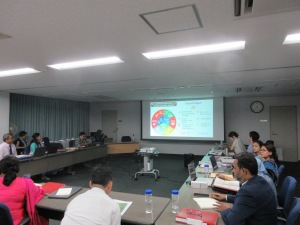 Presentation by a participant
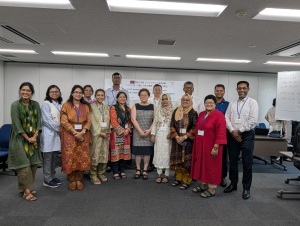 Group photo with Keynote Lecturer
JICA projects in Kenya and Pakistan were presented as case studies to illustrate important perspectives in formulating practical projects.
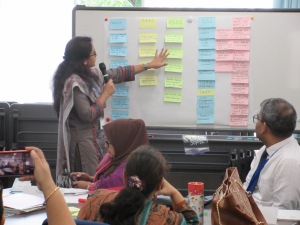 Participants explaining the results of group discussions
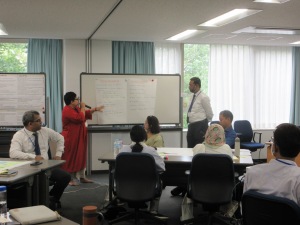
Dr. Kyoko Yamanaka, Director of the Institute for Collaborative Practice, Professor Emeritus at Osaka Prefectural University, delivered a lecture on the significance of collaboration among a wide range of relevant stakeholders, including the administration, the judiciary, healthcare, and NGOs. Dr. Yamanaka also conducted a group discussion over a mock case which made the participants consider survivor centered support facilitated by various stakeholders.
The NPO Women's Network Saya-Saya, which partners with local municipalities, held a workshop to uncover the deep-seated beliefs and biases that are the root of violence. Participants engaged in critical discussions to define the essential structural conditions required to build a non-violent society.
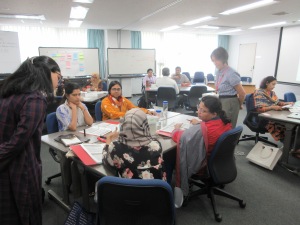 Group work on collaboration based on a mock case
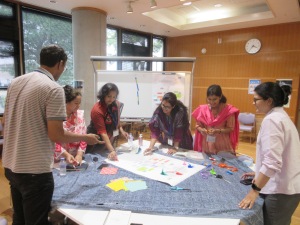 Work on prejudices that underlie violence
Week 2: July 14 (Mon) to 18 (Fri)
Kayomi Kurihara, Chair of the NPO Women's and Human Rights Support Center STEP, conducted an interactive lecture on domestic violence perpetrator program. The participants were deeply impressed and noted that the anger management for perpetrators is necessary in Bangladesh.
Additionally, Miyoko Nagae, Representative Director of the Japan Forensic Human Care Center, provided an overview of the one-stop sexual violence support center in Nagoya. Through her session, participants gained a deeper understanding of trauma-informed care, learning how to support victims struggling with trauma-related symptoms, such as impaired memory and decision-making ability.
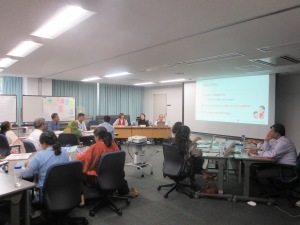 Lecture at JICA Tokyo Center
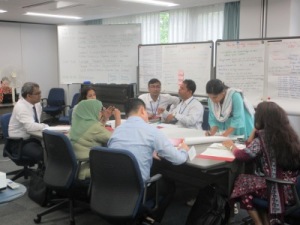 Participants engaged in group discussions
The participants visited the Gender Equality Center Yokohama “Forum”, where they learned about its role as a central hub connecting women to various public support services. They observed how the center fosters women’s empowerment and skill development through its information center and diverse range of seminars.
Prior to this, the participants explored the historical journey of Japanese emigrants to American continents at Japanese Overseas Migration Museum at JICA Yokohama Center.
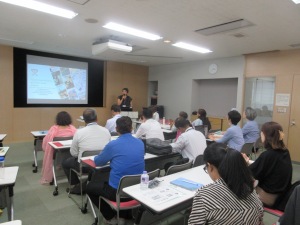 Lecture at the Center for Gender Equality Yokohama
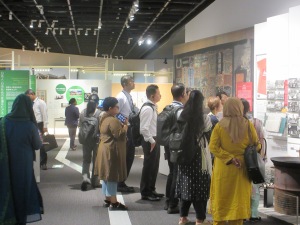 Guided tour of the Japanese Overseas Migration Museum
In a lecture by Yuriko Saito, Specially Appointed Professor at Daito Bunka University, she highlighted the challenges faced by the migrant communities in Japan and the threats posed by the internet and social media to the promotion of a multicultural, co-existence society.
To learn about the roles and activities for supporting GBV survivors at local government level, the participants visited the Nakano City Office in Tokyo. Following the welcome remarks by Naoto Sakai, the mayor of Nakano City, the section manager in charge of universal design presented the gender equality initiatives in the locality and awareness raising programs at public schools. NPO Women's Space Yui, which is based in Nakano City, emphasized that creating an environment where women can live with peace of mind in the community is essential for GBV recovery. They illustrated their community-based support, such as housing support for DV survivors and operation of children's cafeterias (kodomo shokudo).
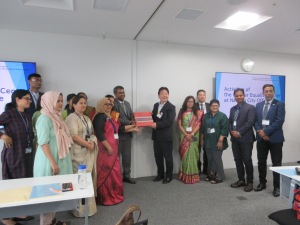 Courtesy Call on the Mayor of Nakano City
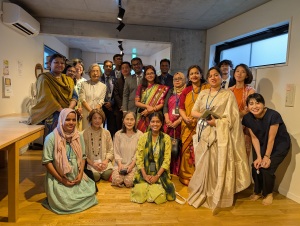 Visiting to the Children's Cafeteria by Women's Space Yui
During the lecture by Takuro Yamashita, Professor of International Cooperation Department at Legal Research Institute, Ministry of Justice, the participants learned about the forensic interview to protect victimized children from secondary damage and trauma.
After the lecture by the representative of NPO Rescue Hub, the participants observed the outreach activities conducted in the evening.
Week 3: Tuesday, July 22 to 25 (Fri)
In a lecture by Child Fund Japan, growing threat of online child sexual exploitation (CSAM: Child Sexual Abuse Materials) was introduced, which has become grave concern in both Japan and Bangladesh. The session emphasized the urgent needs of strengthening legal response in addressing CSAM, and the rapid increase of the harmful incidents caused by AI.
The participants visited the General Incorporated Association, Social Inclusion Support Center. They were impressed with the nationwide hotline and social media consultation services. There was a particularly strong interest in multilingual support, and participants commented that consultation services in their native tongue would make callers more comfortable and easier to consult with.
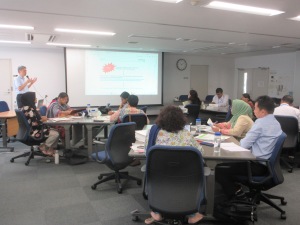 Lecture by Child Fund Japan
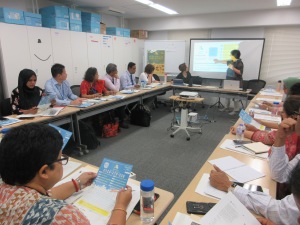 Visit to the Social Inclusion Support Center
The lecture on SOGIESC emphasized the importance of recognizing the unique challenges faced by minorities. It highlighted that developing inclusive support frameworks is essential to ensuring that no one is left behind.
In the final week, the participants collaborated to draft a training plan to be implemented in Cox’s Bazar, Bangladesh and presented it in the online seminar.
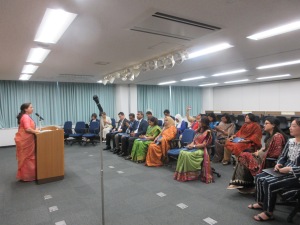
The three-week program in Japan concluded with a closing ceremony, where each participant was awarded a certificate of completion, marking the successful end of the intensive Knowledge Co-Creation Program.
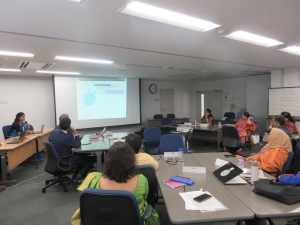 Online Seminar
 Speech by the representative of the participants at the closing ceremony
NWEC would like to take this opportunity to express sincere gratitude to the lecturers from the relevant ministries and agencies, the Nakano City Office, the Gender Equality Center Yokohama, private organizations, practitioners, and experts for their cooperation for this program.
International Cooperation
- International Seminar
- FY2019 Seminar for Gender Equality Officers and Women Leaders in the Asia Region
- FY2018 Seminar for Gender Equality Officers and Women Leaders in the Asia Region
- FY2017 Seminar for Gender Equality Officers and Women Leaders in the Asia Region
- FY2016 Seminar for Gender Equality Officers and Women Leaders in the Asia Region
- FY2015 Seminar for Gender Equality Officers and Women Leaders in the Asia Pacific Region
- FY2014 Seminar for Gender Equality Officers and Women Leaders in the Asia Pacific Region
- FY2013 Seminar for Gender Equality Officers and Women Leaders in the Asia Pacific Region
- FY2012 Seminar for Gender Equality Officers and Women Leaders in the Asia Pacific Region
- FY2011 Seminar for Gender Equality Officer and Women Leaders in the Asia Pacific Region
- FY2010 Empowerment Seminar for Women Leaders in the Asia Pacific Region
- FY2009 Empowerment Seminar for Women Leaders in the Asia Pacific Region Final Report
- FY2008 Empowerment Seminar for Women Leaders in the Asia Pacific Region
- FY2007 Empowerment Seminar for Women Leaders in the Asia Pacific Region
- FY2006 Empowerment Seminar for Women Leaders in the Asia Pacific Region
- NWEC Global Seminar
- FY2025 NWEC Global Seminar: Addressing Technology-Facilitated Gender Based Violence (TFGBV): Approaches to Eradicate the Invisible Harm
- FY2024 NWEC Global Seminar: Gender Equality and Care
- FY2023 NWEC Global Seminar: Gender Mainstreaming & Strengthening Institutional Mechanism with Gender Perspective
- FY2022 NWEC Global Seminar: Does Digital Technology Advance Gender Equality?
- FY2021 NWEC Global Seminar: Combating Gender-Based Violence – “Building Back Better” from the Covid-19 Crisis
- FY2020 NWEC Global Seminar: Covid-19 and Gender
- FY2019 NWEC Global Seminar: Gender and Media
- FY2018 NWEC Global Seminar: Promotion of the Advancement of Women - What Japan can learn from Iceland about Gender Equality?
- FY2017 NWEC Global Seminar: Promotion for Advancement of Women Lessons from Germany
- FY2016 NWEC Global Seminar: Promotion for Advancement of Women –Lessons from Europe
- FY2015 International Symposium: Gender Equality and Women's Empowerment
- FY2014 International Symposium: Keys to Diversity and Women's Leadership
- FY2013 NWEC International Symposium:Gender Equality for Men
- FY2012 NWEC International Symposium:To Make a Society without Violence against Women a Reality
- FY2011 NWEC International Symposium
- FY2010 International Forum for Women's Empowerment
- FY2009 International Forum for Women's Empowerment
- FY2008 International Forum for Women's Empowerment Final Report3
- FY2008 International Forum for Women's Empowerment Final Report2
- FY2008 International Forum for Women's Empowerment Final Report1
- Cooperation with JICA
- FY2025 Knowledge Co-Creation Program (KCCP): "Promotion of Global Networking on Anti-Trafficking in Persons"
- FY2025 Knowledge Co-Creation Program "Eradicating Sexual and Gender-Based Violence (SGBV)"
- FY2025 Knowledge Co-Creation Program: Bangladesh “Strengthening Capacity to Address Gender-Based Violence"
- FY2024 Knowledge Co-Creation Program on "Promotion of Global Networking on Anti-Trafficking in Persons"
- FY2024 Knowledge Co-Creation Program "Eradicating Sexual and Gender-Based Violence (SGBV)"
- FY2023 Knowledge Co-creation Program "Promotion of Networking among ASEAN Countries on Anti-Trafficking in Persons”
- FY2023 Knowledge Co-Creation Program "Eradicating Sexual and Gender-Based Violence (SGBV)"
- FY2022 Knowledge Co-creation Program "Promotion of Networking among ASEAN Countries on Anti-Trafficking in Persons”
- FY2022 Knowledge Co-Creation Program "Eradicating Sexual and Gender-Based Violence (SGBV)"
- FY2021 Knowledge Co-creation Program "Promotion of Networking among ASEAN Countries on Anti-Trafficking in Persons”
- FY2020 Knowledge Co-creation Program "Promotion of Networking among ASEAN Countries on Anti-Trafficking in Persons”
- FY2019 Knowledge Co-creation Program "Promotion of Networking among ASEAN Countries on Anti-Trafficking in Persons”
- FY2018 Knowledge Co-creation Program "Promotion of Networking among ASEAN Countries on Anti-Trafficking in Persons”
- Issue-specific Training “Seminar on Promotiom of Networking among ASEAN Countries on Anti-Trafficking in Persons”
- Basic Information-Gathering Survey/Workshop Seminar on the Economic Independence for Women in Central America and the Caribbean (El Salvador/Dominican Republic)
- Regional Gender Seminar in Central and South America
- 2015 Issue-specific Training "Seminar on Promotion of Networking among Asian Countries on Anti-Trafficking in Persons"
- Seminar on the Promotion of Education for Girls and Women II
- International Conference/International Exchange
- Visit by Professor Hilado from the University of the Philippines Visayas
- Online meeting with Seisen International School elementary students
- Visitor: Mansfield Fellows
- Visitor:JICA Knowledge Co-Creation Program (KCCP) on "Women's Empowerment through Business for Central American Integration System (SICA) Member Countries"
- The 68th Session of the Commission on the Status of Women
- Visitor: Madam Sustjie Mbumba, First Lady of the Republic of Namibia
- Workshop of commemorating the donation of the Beate Shirota Gordon archive materials
- Meeting with Korean Women’s Development Institute (KWDI)
- The Coalition of Finnish Women's Associations (NYTKIS) Secretary General Ms. KAKKOLA’s Courtesy Call to Foreign Minister KAMIKAWA
- The Coalition of Finnish Women's Associations (NYTKIS) Secretary General Ms. KAKKOLA’s Japan Visit Program
- The 67th Session of the Commission on the Status of Women
- NGO CSW67 Forum
- Webinar with Korean Women’s Development Institute (KWDI)
- The 66th Session of the Commission on the Status of Women (Hybrid format)
- Online meeting with international graduate students from the Appropriate Technology course at the University of Tsukuba
- The 65th session of the Commission on the Status of Women
- Lecture "The Beate Sirota Gordon Archives at Mills College"
- Participation in 2nd AGenT
- The 64th session of the Commission on the Status of Women
- Dr. Wang from National Taiwan University visits NWEC
- Japan Network of Women Engineers and Scientists and The Japan Inter-Society Liaison Association Committee for Promoting Equal Participation of Men and Women in Science and Engineering: 9th Japan Korea China Women Leaders Forum for Science & Technology
- Researcher from the KWDI visits NWEC
- Visit by a delegation from the Socialist Republic of Vietnam Ministry of National Defense
- Briefing on the Reykjavik Index for Leadership
- Women's Archives Center Exhibition "Beate Sirota Gordon and gender equality in Japanese Constitution"
- Visit from the Guangxi Women’s Federation
- Participation in the 63rd Session of the Commission on the Status of Women
- 7th Global Forum on Gender Statistics
- FY2018 International Symposium hosted by Korean Institute for Gender Equality Promotion and Education “Gender Equality at Schools”
- Visit from All-China Women’s Federation(ACWF)
- Participation in the 62nd Session of the Commission on the Status of Women
- The 14th KIGEPE International Symposium “Empowering Women’s Leadership: expanding influence and innovation”
- Participation in the 61st Session of the Commission on the Status of Women
- Visit from the Batis Center for Women
- 2011 Asia Women Eco-Science Forum (a forum of science and engineering leaders in Japan, China and Korea)
- The 60th Session of the Commission on the Status of Women
- The 59th Session of the United Nations Commission on the Status of Women
- The 58th Commission on the Status of Women
- The 57th Session of the United Nations Commission on the Status of Women
- International Symposium: Gender Awareness Education for Sustainable Development
- Thirtieth Anniversary Programs
- Attendance at the Ceremony Commemorating the 25th Anniversary of the Korean Women’s Development Institute (KWDI)
- Japanese-Filipino children (JFC)* from the Philippines-based NGO “DAWN” visit the Center
- Visitors from Abroad to NWEC
- Research report on Multicultural Family Support in South Korea
- Workshop on Gender and Education: Life-long Learning for Women’s Empowerment
- Lecture Delivered by a Visiting Researcher
- Connections: Bringing Together the Next Generation of Women Leaders in Science, Technology, Engineering and Mathematics
- Conclusion of Memorandum of Understanding on Exchange and Cooperation with the Ministry of Women's Affairs, Royal Government of Cambodia
- Visit to Japan by the Minister of Women’s Affairs of the Royal Government of Cambodia
- KIGEPE Delegation Visit
- Officials of Ministry of Information and Communications of the Socialist Republic of Vietnam visited NWEC
- The 56th Commission on the Status of Women
- Dr. Barker's visit
- Multidisciplinary Intellectual Exchange for Women Leaders from the United States, Japan, South Korea and the Philippines
- Courtesy visit to University of Hawai`i
- Delegation of Board for the Advancement of Women, Ministry of Finance of the Socialist Republic of Vietnam visited NWEC
- Visit Korean Women's Development Institute (KWDI)
- Report on Participation in the 5th World Social Forum on Migration
- A group led by the Vice President of the Korean Women's Development Institute visited NWEC
- A disaster management specialist from India visits the Center
- Visit to the Korean Institute for Gender Equality Promotion & Education (KIGEPE) and others
- Secretary of State, Ministry of Justice, Kingdom of Cambodia visited NWEC
- Research conducted in the Republic of the Philippines
- Research on the Comparative Study of the Gender Equality Policy in Southeast Asian Countries in the Kingdom of Cambodia
- Ochanomizu University and A Canadian Women’s Study Researcher visited NWEC
- Aigyung Yang, Research Fellow and Former Director of Strategy Board for Women Friendly Policies of the Korean Women's Development Institute (KWDI) Visits NWEC
- Delegation of the Ministry of Defense of the Socialist Republic of Vietnam visited NWEC
- Delegation from the Women and Development Center, of the Vietnam Women's Union, Visited NWEC
- The "7th Asia-Pacific Forum on Development and Gender" was held in Seoul, South Korea
- HOME
- International Cooperation
- Cooperation with JICA
- Cooperation with JICA
- FY2025 Knowledge Co-Creation Program: Bangladesh “Strengthening Capacity to Address Gender-Based Violence"