International Conference/International Exchange
- HOME
- International Cooperation
- International Conference/International Exchange
- The 69th Session of the Commission on the Status of Women
International Conference/International Exchange
- CSW
-
The 69th Session of the Commission on the Status of Women
Date: March 10 to 21, 2025
The sixty-nineth session of the Commission on the Status of Women (CSW69) was held from March 10 to 21, 2025.
Overview of CSW69
The sixty-nineth session of the Commission on the Status of Women was held in person at the United Nations Headquarters in New York (Some speakers participated online). This year marks 30 years since the 4th World Conference on Women held in Beijing in 1995 ("Beijing + 30"). About 13,000 world leaders and representatives of civil society organizations, including a Vice-President, three Vice-Prime Ministers, and 97 Ministers gathered in New York.
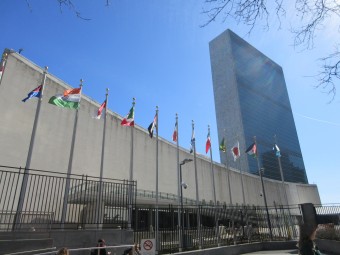 United Nations Headquarters in New York
CSW69 was chaired by H.E. Mr. Abdulaziz Alwasil, Ambassador of Saudi Arabia to the United Nations. The opening ceremony of CSW69 began with a performance of Saudi Arabian traditional music composed for the session. Then,3 youth representatives advocated for STEM education for girls, inclusion of indigenous women in the decision-making process, and funding for women's organizations as justice rather than charity. Next, representatives from the UN Secretary-General, UN Women Executive Director and ECOSOC Chairperson highlighted that while progress has been made in advancing gender equality and women's empowerment over the past 30 years since Beijing, it has been slow, and there are needs to address regional disparities, discrimination based on intersectionality and gender diversity. They presented strong commitments to push for gender equality by encouraging collaboration among the governments, civil society, youth, persons with disabilities and indigenous peoples, rather than stand still in the face of backlash against achievements in gender equality and women's empowerment around the world.
Following the opening ceremony, general discussion, ministerial roundtable, and interactive discussion were taken place. Participants stated that legal and institutional reforms toward gender equality and the empowerment of women and girls have been implemented in various countries and regions, however, policy implementation is lagging behind.
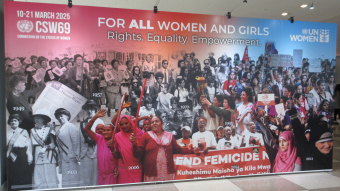 CSW69 banner at UN Headquarters
Disseminating activities in Japan
From Japan, Parliamentary Vice-Minister for Foreign Affairs Eri Arfiya made remarks at the general discussion and ministerial roundtable held on the 12th. Her remarks outlined the support measures contributing to women's economic independence, making it compulsory for private companies over a certain size to disclose the information of gender pay gap and rate of male employees taking paternity leave based on the Basic Plan for Gender Equality, Japan's initiatives for Women, Peace and Security (WPS) and the Global Partnership for action on gender based against online harassment and abuse.
(https://www.mofa.go.jp/press/release/pressite_000001_01085.html)
At the interactive panel with youth held on the 14th, Ms. Momoko Yokoi, the youth representative of Japan, made remarks. She stressed that persistent sexual violence that has not been eradicated even 30 years since the Beijing Conference. She continued that a half of victims of sexual assault and harassment in Japan are under the age of 19, and some young survivors are not protected because they do not complain. She called for the actions to incorporate the discussions at CSW into real and lasting change, and involving youth in implementing policy that is based on the Beijing Platform for Action.
On the final day of the session (March 21st), participating counties expressed their views on the Political Declaration adopted on the first day, such as announcing that the interpretation of "gender" to be limited to "men and women", expressing regret over the absence of sexual and reproductive health and rights, and calling for solidarity against attacks on gender equality. Ms. Asako Osaki, Representative of Japan, commended the member countries’ commitments to consensus building attitudes during the negotiation process, and also appreciated that the political declaration included the National Action Plan, peace building, rehabilitation after the conflicts, and humanitarian assistance despite of the regrettable absence of Security Council Resolution 1325 and WPS. She also expressed regret that sexual and reproductive health and rights, which was unanimously agreed on at the Beijing Conference, was not included. Her statement concluded by delivering that Japan will contribute to Gender equality and women’s empowerment in Japan and across the international community in cooperating with various stakeholders, including UN agencies and civil society.
On the 13th, the Permanent Mission of Japan to the United Nations and three Japanese women's non-governmental organizations co-hosted a side event titled "What can NGOs do to promote the concept of “Women, Peace and Security” to our global audience?". A university student from Nagasaki who is a third-generation A-bomb survivor appealed for the importance of peace education. The Ministry of Foreign Affairs presented that Japan has been working on disaster response measures that are included in WPS. The Japan International Cooperation Agency (JICA) also shared their activities to improve livelihoods through vocational training for women in the Sudan and reintegration support for victims of violence in Pakistan, underscoring the importance of WPS not only for conflict situations but also for the everyday situations from the perspective of building a society where rights are not infringed by violence.
Political Declaration
The political declaration of CSW69 has been adopted on the first day (March 10th). It incorporated discussions based on the progress reports compiled by the countries and regions prior to the conference.
The political declaration emphasized that although 30 years have passed since the 4th World Conference on Women and some progress has been made, no country has achieved gender equality and the gender gap has not yet closed. It pointed out the delay in realizing Beijing Declaration and Platform for Action, the Outcome Document of the 23rd Special Session of the UN General Assembly, the ratification of the Convention on the Elimination of All Forms of Discrimination against Women and its Optional Protocol, and the 2030 Agenda for Sustainable Development. It also argued that progress has been minimal due to the lack of women's participation in decision-making, multiple and intersectional forms of discrimination that women suffer throughout their lives, and their vulnerability and marginalization.
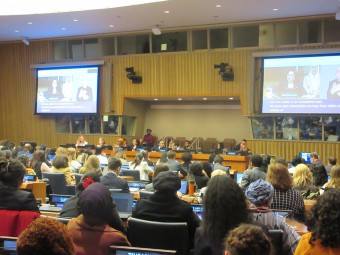 UN Women Executive Director Bahous delivers a speech at the closing ceremony
Disseminating Information from NWEC
During the CSW, active discussions are conducted every year, including presentations of the roles and activities of civil society organizations in improving the status of women. This year, representatives of 5,845 civil society organizations and NGOs participated from all over the world, including Japan.
The NGO CSW/NY, which supports the participation of civil society organizations in the CSW, set up venues inside and outside the UN Building and an online platform, where many parallel events were held by civil society organizations.
The National Women's Education Center (NWEC) also set up an exhibition booth on the online platform, which introduced the roles and activities of NWEC through the message form president of NWEC, gender statistic leaflet and other educational materials.
NGO CSW69 Forum/NWEC Booth
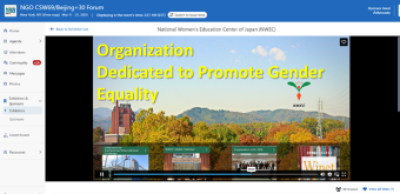

International Cooperation
- International Seminar
- FY2019 Seminar for Gender Equality Officers and Women Leaders in the Asia Region
- FY2018 Seminar for Gender Equality Officers and Women Leaders in the Asia Region
- FY2017 Seminar for Gender Equality Officers and Women Leaders in the Asia Region
- FY2016 Seminar for Gender Equality Officers and Women Leaders in the Asia Region
- FY2015 Seminar for Gender Equality Officers and Women Leaders in the Asia Pacific Region
- FY2014 Seminar for Gender Equality Officers and Women Leaders in the Asia Pacific Region
- FY2013 Seminar for Gender Equality Officers and Women Leaders in the Asia Pacific Region
- FY2012 Seminar for Gender Equality Officers and Women Leaders in the Asia Pacific Region
- FY2011 Seminar for Gender Equality Officer and Women Leaders in the Asia Pacific Region
- FY2010 Empowerment Seminar for Women Leaders in the Asia Pacific Region
- FY2009 Empowerment Seminar for Women Leaders in the Asia Pacific Region Final Report
- FY2008 Empowerment Seminar for Women Leaders in the Asia Pacific Region
- FY2007 Empowerment Seminar for Women Leaders in the Asia Pacific Region
- FY2006 Empowerment Seminar for Women Leaders in the Asia Pacific Region
- NWEC Global Seminar
- FY2025 NWEC Global Seminar: Addressing Technology-Facilitated Gender Based Violence (TFGBV): Approaches to Eradicate the Invisible Harm
- FY2024 NWEC Global Seminar: Gender Equality and Care
- FY2023 NWEC Global Seminar: Gender Mainstreaming & Strengthening Institutional Mechanism with Gender Perspective
- FY2022 NWEC Global Seminar: Does Digital Technology Advance Gender Equality?
- FY2021 NWEC Global Seminar: Combating Gender-Based Violence – “Building Back Better” from the Covid-19 Crisis
- FY2020 NWEC Global Seminar: Covid-19 and Gender
- FY2019 NWEC Global Seminar: Gender and Media
- FY2018 NWEC Global Seminar: Promotion of the Advancement of Women - What Japan can learn from Iceland about Gender Equality?
- FY2017 NWEC Global Seminar: Promotion for Advancement of Women Lessons from Germany
- FY2016 NWEC Global Seminar: Promotion for Advancement of Women –Lessons from Europe
- FY2015 International Symposium: Gender Equality and Women's Empowerment
- FY2014 International Symposium: Keys to Diversity and Women's Leadership
- FY2013 NWEC International Symposium:Gender Equality for Men
- FY2012 NWEC International Symposium:To Make a Society without Violence against Women a Reality
- FY2011 NWEC International Symposium
- FY2010 International Forum for Women's Empowerment
- FY2009 International Forum for Women's Empowerment
- FY2008 International Forum for Women's Empowerment Final Report3
- FY2008 International Forum for Women's Empowerment Final Report2
- FY2008 International Forum for Women's Empowerment Final Report1
- Cooperation with JICA
- FY2025 Knowledge Co-Creation Program (KCCP): "Promotion of Global Networking on Anti-Trafficking in Persons"
- FY2025 Knowledge Co-Creation Program "Eradicating Sexual and Gender-Based Violence (SGBV)"
- FY2025 Knowledge Co-Creation Program: Bangladesh “Strengthening Capacity to Address Gender-Based Violence"
- FY2024 Knowledge Co-Creation Program on "Promotion of Global Networking on Anti-Trafficking in Persons"
- FY2024 Knowledge Co-Creation Program "Eradicating Sexual and Gender-Based Violence (SGBV)"
- FY2023 Knowledge Co-creation Program "Promotion of Networking among ASEAN Countries on Anti-Trafficking in Persons”
- FY2023 Knowledge Co-Creation Program "Eradicating Sexual and Gender-Based Violence (SGBV)"
- FY2022 Knowledge Co-creation Program "Promotion of Networking among ASEAN Countries on Anti-Trafficking in Persons”
- FY2022 Knowledge Co-Creation Program "Eradicating Sexual and Gender-Based Violence (SGBV)"
- FY2021 Knowledge Co-creation Program "Promotion of Networking among ASEAN Countries on Anti-Trafficking in Persons”
- FY2020 Knowledge Co-creation Program "Promotion of Networking among ASEAN Countries on Anti-Trafficking in Persons”
- FY2019 Knowledge Co-creation Program "Promotion of Networking among ASEAN Countries on Anti-Trafficking in Persons”
- FY2018 Knowledge Co-creation Program "Promotion of Networking among ASEAN Countries on Anti-Trafficking in Persons”
- Issue-specific Training “Seminar on Promotiom of Networking among ASEAN Countries on Anti-Trafficking in Persons”
- Basic Information-Gathering Survey/Workshop Seminar on the Economic Independence for Women in Central America and the Caribbean (El Salvador/Dominican Republic)
- Regional Gender Seminar in Central and South America
- 2015 Issue-specific Training "Seminar on Promotion of Networking among Asian Countries on Anti-Trafficking in Persons"
- Seminar on the Promotion of Education for Girls and Women II
- International Conference/International Exchange
- The 69th Session of the Commission on the Status of Women
- Visit by Taiwan's K-12 Education Administration, Ministry of Education
- Participation in the 17th Asia-Pacific Forum on Development and Gender Hosted by KWDI, and a Visit to KIGEPE
- Participation in the Ninth Tokyo International Conference on African Development (TICAD 9)
- Visit by Professor Hilado from the University of the Philippines Visayas
- Online meeting with Seisen International School elementary students
- Visitor: Mansfield Fellows
- Visitor:JICA Knowledge Co-Creation Program (KCCP) on "Women's Empowerment through Business for Central American Integration System (SICA) Member Countries"
- The 68th Session of the Commission on the Status of Women
- Visitor: Madam Sustjie Mbumba, First Lady of the Republic of Namibia
- Workshop of commemorating the donation of the Beate Shirota Gordon archive materials
- Meeting with Korean Women’s Development Institute (KWDI)
- The Coalition of Finnish Women's Associations (NYTKIS) Secretary General Ms. KAKKOLA’s Courtesy Call to Foreign Minister KAMIKAWA
- The Coalition of Finnish Women's Associations (NYTKIS) Secretary General Ms. KAKKOLA’s Japan Visit Program
- The 67th Session of the Commission on the Status of Women
- NGO CSW67 Forum
- Webinar with Korean Women’s Development Institute (KWDI)
- The 66th Session of the Commission on the Status of Women (Hybrid format)
- Online meeting with international graduate students from the Appropriate Technology course at the University of Tsukuba
- The 65th session of the Commission on the Status of Women
- Lecture "The Beate Sirota Gordon Archives at Mills College"
- Participation in 2nd AGenT
- The 64th session of the Commission on the Status of Women
- Dr. Wang from National Taiwan University visits NWEC
- Japan Network of Women Engineers and Scientists and The Japan Inter-Society Liaison Association Committee for Promoting Equal Participation of Men and Women in Science and Engineering: 9th Japan Korea China Women Leaders Forum for Science & Technology
- Researcher from the KWDI visits NWEC
- Visit by a delegation from the Socialist Republic of Vietnam Ministry of National Defense
- Briefing on the Reykjavik Index for Leadership
- Women's Archives Center Exhibition "Beate Sirota Gordon and gender equality in Japanese Constitution"
- Visit from the Guangxi Women’s Federation
- Participation in the 63rd Session of the Commission on the Status of Women
- 7th Global Forum on Gender Statistics
- FY2018 International Symposium hosted by Korean Institute for Gender Equality Promotion and Education “Gender Equality at Schools”
- Visit from All-China Women’s Federation(ACWF)
- Participation in the 62nd Session of the Commission on the Status of Women
- The 14th KIGEPE International Symposium “Empowering Women’s Leadership: expanding influence and innovation”
- Participation in the 61st Session of the Commission on the Status of Women
- Visit from the Batis Center for Women
- 2011 Asia Women Eco-Science Forum (a forum of science and engineering leaders in Japan, China and Korea)
- The 60th Session of the Commission on the Status of Women
- The 59th Session of the United Nations Commission on the Status of Women
- The 58th Commission on the Status of Women
- The 57th Session of the United Nations Commission on the Status of Women
- International Symposium: Gender Awareness Education for Sustainable Development
- Thirtieth Anniversary Programs
- Attendance at the Ceremony Commemorating the 25th Anniversary of the Korean Women’s Development Institute (KWDI)
- Japanese-Filipino children (JFC)* from the Philippines-based NGO “DAWN” visit the Center
- Visitors from Abroad to NWEC
- Research report on Multicultural Family Support in South Korea
- Workshop on Gender and Education: Life-long Learning for Women’s Empowerment
- Lecture Delivered by a Visiting Researcher
- Connections: Bringing Together the Next Generation of Women Leaders in Science, Technology, Engineering and Mathematics
- Conclusion of Memorandum of Understanding on Exchange and Cooperation with the Ministry of Women's Affairs, Royal Government of Cambodia
- Visit to Japan by the Minister of Women’s Affairs of the Royal Government of Cambodia
- KIGEPE Delegation Visit
- Officials of Ministry of Information and Communications of the Socialist Republic of Vietnam visited NWEC
- The 56th Commission on the Status of Women
- Dr. Barker's visit
- Multidisciplinary Intellectual Exchange for Women Leaders from the United States, Japan, South Korea and the Philippines
- Courtesy visit to University of Hawai`i
- Delegation of Board for the Advancement of Women, Ministry of Finance of the Socialist Republic of Vietnam visited NWEC
- Visit Korean Women's Development Institute (KWDI)
- Report on Participation in the 5th World Social Forum on Migration
- A group led by the Vice President of the Korean Women's Development Institute visited NWEC
- A disaster management specialist from India visits the Center
- Visit to the Korean Institute for Gender Equality Promotion & Education (KIGEPE) and others
- Secretary of State, Ministry of Justice, Kingdom of Cambodia visited NWEC
- Research conducted in the Republic of the Philippines
- Research on the Comparative Study of the Gender Equality Policy in Southeast Asian Countries in the Kingdom of Cambodia
- Ochanomizu University and A Canadian Women’s Study Researcher visited NWEC
- Aigyung Yang, Research Fellow and Former Director of Strategy Board for Women Friendly Policies of the Korean Women's Development Institute (KWDI) Visits NWEC
- Delegation of the Ministry of Defense of the Socialist Republic of Vietnam visited NWEC
- Delegation from the Women and Development Center, of the Vietnam Women's Union, Visited NWEC
- The "7th Asia-Pacific Forum on Development and Gender" was held in Seoul, South Korea
- HOME
- International Cooperation
- International Conference/International Exchange
- International Conference/International Exchange
- The 69th Session of the Commission on the Status of Women